Why Do We Pay for a Neutral Grounding Resistor (NGR) When the Earth Is Free?
Writer: admin Time:2026-02-24 15:05:00 Browse:170℃
In the world of electrical engineering, there is a common misconception that since the "Earth" is a free, universal conductor, spending thousands of dollars on a Neutral Grounding Resistor (NGR) is an unnecessary expense. In Low Voltage (LV) systems, such as 230V or 415V, we often get away with "solid grounding"—connecting the transformer neutral directly to the earth. At these levels, fault currents are generally manageable, and standard circuit breakers trip fast enough to prevent total destruction. However, the moment we step into Medium Voltage (MV) territory—6.6 kV, 11 kV, 22 kV, or 33 kV—the physics of electricity changes the stakes. In these environments, "free" earth grounding becomes an invitation to catastrophic equipment failure.
To understand why we invest in an NGR, we must look beyond the circuit diagram and look at the control of energy. In an MV system, a single line-to-ground fault is not a minor event; it is a violent release of energy. Without an NGR, the fault current is limited only by the inherent impedance of the source and the soil, often reaching levels of 10,000 to 20,000 Amperes. At these magnitudes, the heat generated (I2R) is so intense that it doesn't just trip a breaker; it melts copper, vaporizes steel, and causes "stator core burning" in expensive generators. An NGR is essentially a massive safety valve designed to limit this current to a pre-determined, safe value—typically between 50A and 400A.
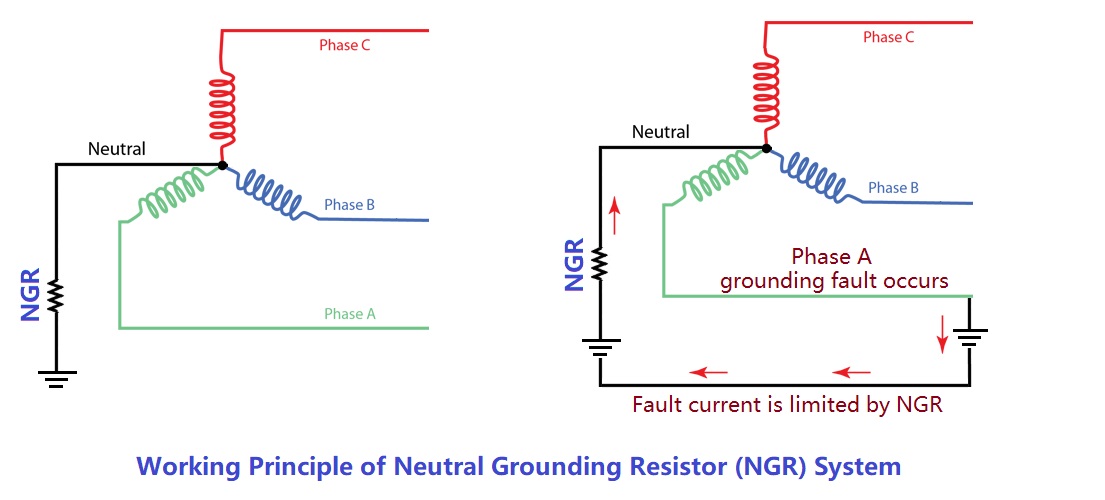
Consider a real-world industrial scenario involving an 11 kV captive power plant. If a motor winding insulation fails and the system is solidly grounded, the resulting ground fault current would be massive. The electromagnetic forces generated by 15,000A rushing through the fault point could physically bend the generator’s internal busbars and fuse the laminations of the stator core. Once a stator core is "burned" or fused, the generator is often a total loss. Replacing a 10 MW generator can cost millions of dollars and involve a lead time of six to twelve months. By contrast, an NGR limits that same fault to 200A. At this level, the damage is localized to a small puncture in the insulation. The generator can be repaired on-site by a technician in a matter of days for a fraction of the cost.
Furthermore, the NGR plays a critical role in managing Transient Overvoltages. In ungrounded or poorly grounded systems, a phenomenon known as "arcing ground faults" can occur. This happens when a fault intermittently flashes over and extinguishes. Each time the arc reignites, it can "trap" charge in the system's capacitance, causing the voltage on the healthy phases to skyrocket to 300% or 500% of their nominal value. This leads to a "domino effect" where the insulation of healthy motors and cables across the entire facility fails simultaneously. The NGR acts as a dampener, providing a path to dissipate this energy and stabilizing the system voltage during a fault.
From a protection philosophy standpoint, the NGR provides the "Goldilocks" zone for relay coordination. If the grounding is too "weak" (high resistance), the current is too small for standard Current Transformers (CTs) and relays to detect, allowing the fault to persist and create a fire hazard. If the grounding is too "strong" (solid), the current is too high and destroys the equipment before the breaker even moves. The NGR allows engineers to tune the fault current so it is high enough to be detected by sensitive earth-fault relays (like the 50N/51N or 64G), but low enough to prevent melting the equipment.
Industrial standards like IEEE 142 (The Green Book) and IEC 61936-1 do not merely suggest the use of NGRs in MV systems; they effectively mandate them as best practice for reliability. For any facility where "uptime" translates to revenue—such as data centers, oil refineries, or mining operations—the NGR is the most cost-effective insurance policy available. It buys the protection system the critical milliseconds it needs to isolate a fault without sacrificing the multimillion-dollar assets it is designed to protect.
In conclusion, we do not pay for an NGR because the Earth is expensive. We pay for it because uncontrolled energy is destructive. The Earth provides the path, but the NGR provides the discipline. In the high-stakes environment of Medium Voltage power, an NGR doesn't just save equipment; it saves the bottom line by turning a potential explosion into a routine maintenance event.
CATEGORIES
- Neutral Grounding Resistor for Transformer
- Generator Neutral Grounding Resistor
- Low Voltage Neutral Grounding Resistor
- Neutral Grounding Arc Suppression Coils (Peterson Coil)
- Neutral Point Gap Grounding Protection Device
- Nitrogen Injection Fire Protection System for Transformer (NIFPS)
- Transformer Air-Cooled Control Equipment
- Nonlinear Neutral Grounding Equipment
LATEST NEWS
- Why Does the Neutral Point of a Large Generator Need to be Reliably Grounded?
- Transformer Neutral Grounding Methods and Applications for High-, Medium-, and Low-Voltage Systems
- How to Accurately Calculate the Neutral Grounding Resistance Value of a Transformer
- Global Top 8 Neutral Grounding Resistor (NGR)Manufacturers
- How to Accurately Select the Insulation Level of a Neutral Grounding Resistor?
CONTACT US
WhatsApp:
Tel: +86-312-5959618
Email: info@orionresistors.com
Add: No. 79, Fuchang Road, Zhongguancun Entrepreneurship Base, Baoding City,China