Earthing vs. Grounding
Writer: admin Time:2026-04-29 10:28:27 Browse:223℃
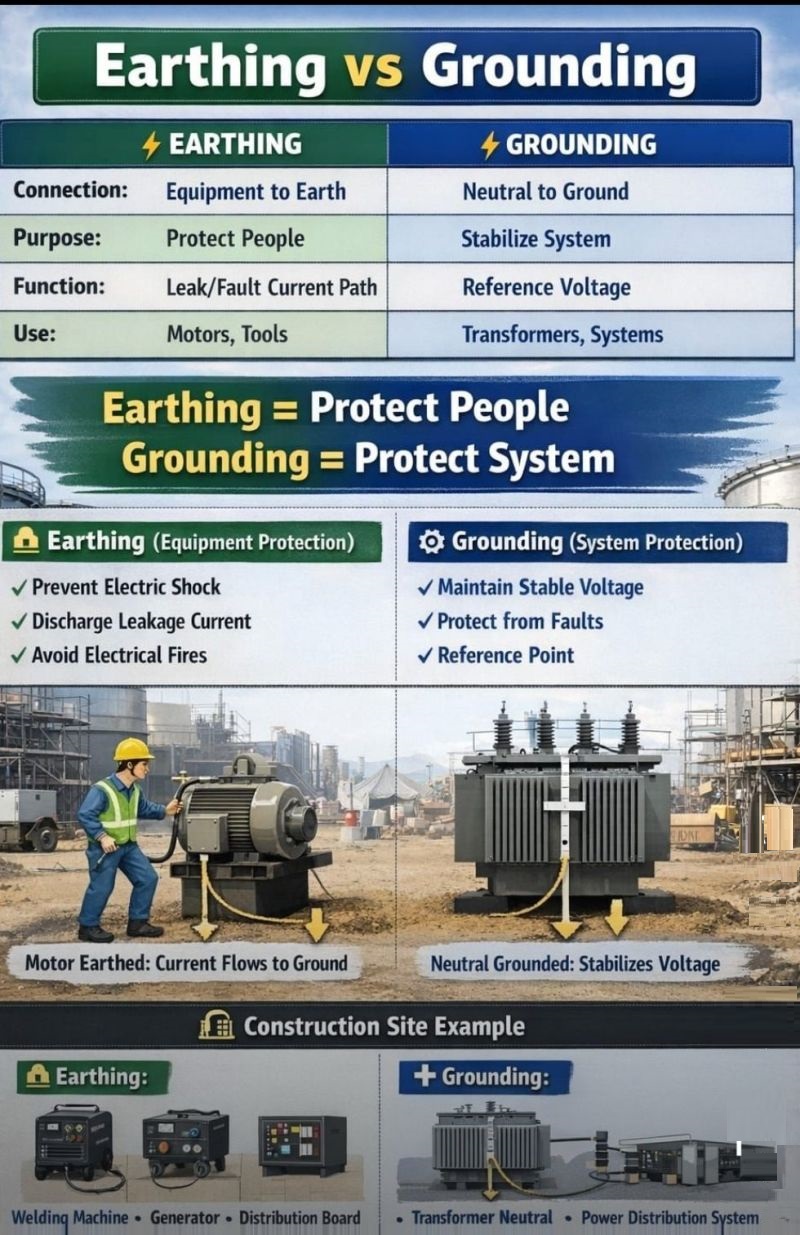
1. Earthing: Protection for People
Earthing refers to the process of connecting the metallic non-current-carrying parts of an electrical device (such as the metal frame or enclosure) directly to the earth. Its primary logic is "Divert and Defend."
Under normal conditions, the earthing conductor carries no current. However, if the insulation fails and a live wire touches the metal casing, the earthing wire provides a path of least resistance for the leakage current to flow into the ground. This prevents the metal body from becoming energized, thereby protecting users from fatal electric shocks. Furthermore, this surge in current is designed to trip circuit breakers or RCDs (Residual Current Devices) immediately, cutting off the power and preventing electrical fires.
2. Grounding: Stability for the System
Grounding (often referred to as System Grounding) involves connecting the current-carrying part of an electrical system—typically the neutral point of a transformer or generator—to the earth. Its primary logic is "Balance and Reference."
Unlike earthing, grounding is designed to provide a zero-potential reference point for the entire electrical network. By grounding the neutral point, the system can maintain stable voltage levels across all phases, even during lightning strikes, switching surges, or unbalanced loads. In some system configurations, the grounding conductor may carry current during normal operation to balance the circuit. This is the backbone of reliability for power plants, substations, and distribution networks.
3. Key Differences at a Glance
| Feature | Earthing (Protective) | Grounding (Functional) |
| Primary Goal | Human Safety (Preventing shock) | System Stability (Voltage regulation) |
Connection Point | Metal Enclosure of equipment | Neutral Point of the circuit |
| Current Flow | Only during a fault or leakage | May flow during normal or unbalanced operation |
| Used In | Appliances, motors, distribution boards | Transformers, generators, power grids |
| Main Benefit | Protects lives and prevents fires | Protects equipment and stabilizes voltage |
4. Industrial Application Summary
In a professional industrial environment, both systems work in tandem to ensure total safety:
From a Safety Officer’s Perspective: You must ensure that every machine on the factory floor is properly Earthed. If a wire looses due to vibration and touches the machine frame, the earthing is what saves the operator's life.
From an Electrical Engineer’s Perspective: You must ensure the facility’s transformer is correctly Grounded. If the grounding fails, the system voltage could float or spike, leading to the catastrophic failure of sensitive electronic controllers or motors.
In Simple Terms:
Earthing is the "Bulletproof Vest" for the Operator.
Grounding is the "Stabilizer" for the Grid.
CATEGORIES
- Neutral Grounding Resistor for Transformer
- Generator Neutral Grounding Resistor
- Low Voltage Neutral Grounding Resistor
- Neutral Grounding Arc Suppression Coils (Peterson Coil)
- Neutral Point Gap Grounding Protection Device
- Nitrogen Injection Fire Protection System for Transformer (NIFPS)
- Transformer Air-Cooled Control Equipment
- Nonlinear Neutral Grounding Equipment
LATEST NEWS
- Why Does the Neutral Point of a Large Generator Need to be Reliably Grounded?
- Transformer Neutral Grounding Methods and Applications for High-, Medium-, and Low-Voltage Systems
- How to Accurately Calculate the Neutral Grounding Resistance Value of a Transformer
- Global Top 8 Neutral Grounding Resistor (NGR)Manufacturers
- How to Accurately Select the Insulation Level of a Neutral Grounding Resistor?
CONTACT US
WhatsApp:
Tel: +86-312-5959618
Email: info@orionresistors.com
Add: No. 79, Fuchang Road, Zhongguancun Entrepreneurship Base, Baoding City,China