The most comprehensive list of transformer grounding methods and types
Writer: admin Time:2026-02-24 16:14:17 Browse:258℃
Why It’s Not Just One-Size-Fits-All
Proper earthing is the backbone of power system stability and safety. But did you know there are different types of earthing depending on whether you’re protecting people, equipment, or signals?
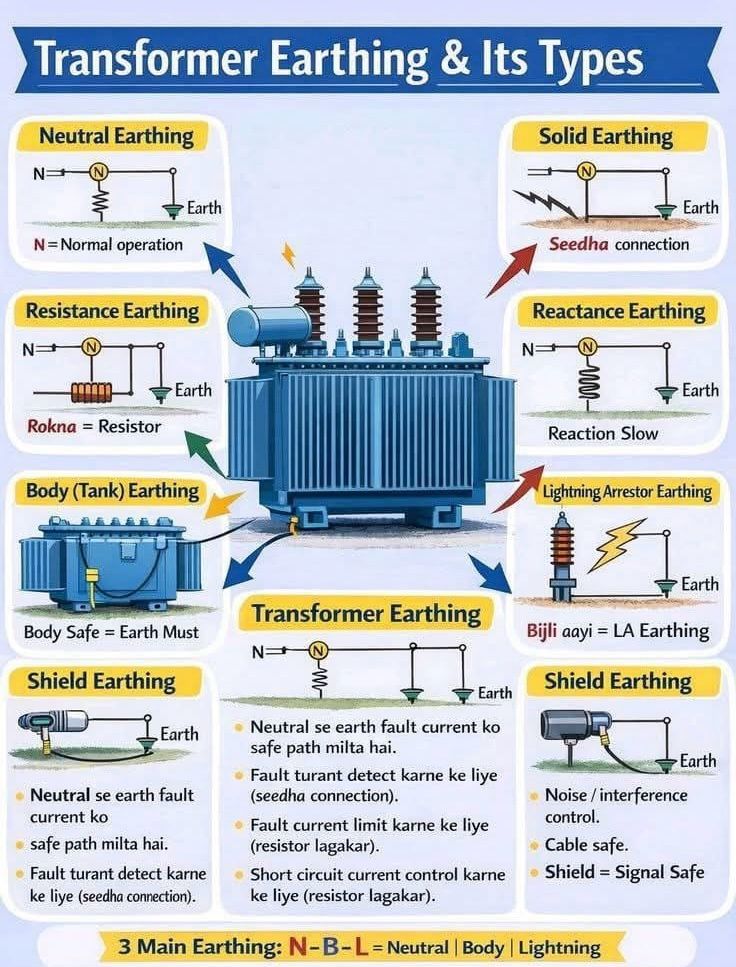
The main earthing types can be summarized by N-B-L:
🔹 Neutral Earthing (N): Provides a safe path for earth fault currents back to the source.
▫️Solid Earthing: Direct connection for fast fault detection. Best for LV systems.
▫️Resistance Earthing: Uses a resistor to limit fault current and prevent equipment damage.
▫️Reactance Earthing: Controls short-circuit current by slowing down the system's reaction.
🔹 Body (Tank) Earthing (B): This is mandatory for human safety. It connects the non-current carrying metal parts (the tank) to the earth, preventing electric shocks if insulation fails. 🛡️
🔹 Lightning Arrestor (LA) Earthing (L): An independent system designed to safely discharge high-voltage surges from lightning strikes directly into the ground.
🔹 Shield Earthing: Critical for signal integrity! It reduces noise and electromagnetic interference (EMI) to keep your control cables and signals safe.(eg: K-Rated transformers,Inverter duty isolation transformers)
🟥 standard power and distribution transformers typically do not have an electrostatic shield (shield earthing) between their windings as a default feature.(apology for the confusion caused by the post)
Effective earthing ensures that when a fault occurs, it is detected immediately and handled safely without catastrophic failure
CATEGORIES
- Neutral Grounding Resistor for Transformer
- Generator Neutral Grounding Resistor
- Low Voltage Neutral Grounding Resistor
- Neutral Grounding Arc Suppression Coils (Peterson Coil)
- Neutral Point Gap Grounding Protection Device
- Nitrogen Injection Fire Protection System for Transformer (NIFPS)
- Transformer Air-Cooled Control Equipment
- Nonlinear Neutral Grounding Equipment
LATEST NEWS
- Why Does the Neutral Point of a Large Generator Need to be Reliably Grounded?
- Transformer Neutral Grounding Methods and Applications for High-, Medium-, and Low-Voltage Systems
- How to Accurately Calculate the Neutral Grounding Resistance Value of a Transformer
- Global Top 8 Neutral Grounding Resistor (NGR)Manufacturers
- What Are the Routine and Type Tests for a Transformer Neutral Grounding Resistor (NGR)?
CONTACT US
WhatsApp:
Tel: +86-312-5959618
Email: info@orionresistors.com
Add: No. 79, Fuchang Road, Zhongguancun Entrepreneurship Base, Baoding City,China