Why Do Neutral Grounding Resistor (NGR)Need Intelligent Monitoring?
Writer: admin Time:2026-09-14 16:16:17 Browse:9℃
With the rapid expansion of renewable energy and the advancing digitalization of power grids worldwide, power system architectures are becoming increasingly complex. Massive integration of wind, solar PV, battery energy storage systems (BESS), and distributed energy resources (DERs)—along with the rising underground cabling rate in distribution networks—presents complex ground-fault conditions for transformers, generators, and medium-voltage networks. Against this backdrop, Neutral Grounding Resistors (NGRs) are evolving from traditional passive current-limiting devices into intelligent grounding equipment integrating monitoring, protection, event logging, and communication.
1. Grid Intelligence Drives NGR Technology Upgrades
The fundamental duty of an NGR remains unchanged: when a single-phase-to-ground fault occurs, it limits the neutral fault current to protect transformers, generators, cables, and switchgear from thermal and mechanical stress while providing reliable current for ground-fault protection.
However, today's grid operating environment has shifted significantly. According to International Energy Agency (IEA) forecasts, global renewable energy capacity will grow by approximately 4,600 GW from 2025 to 2030, driven primarily by solar PV and wind. Concurrently, annual global electricity grid investment has reached around USD 400 billion. The influx of renewables, storage, and power electronics makes grid operations far more dynamic and fault characteristics increasingly complex. Consequently, an NGR can no longer act merely as a passive fault current limiter; operators require real-time visibility into the health and status of the entire grounding system.
2. Why Transformers and Generators Require Intelligent NGRs
For transformers, the neutral grounding method directly affects single-phase ground-fault current magnitudes and relay protection performance. For synchronous generators, neutral grounding safeguards stator windings and core laminations during ground faults.
IEC 60076-25:2023 specifically addresses neutral grounding resistors for transformers and generators. For instance, in a 10 kV system with a target ground-fault current of 500 A, the theoretical resistance is calculated as:
R≈ 10,000/ (√3x500)≈ 11.55Ω
However, actual NGR selection depends not only on resistance values but also on fault duration, thermal rating, insulation levels, environmental conditions, and relay coordination. An NGR is not merely a "simple resistor"—it is a critical subsystem within neutral grounding protection.
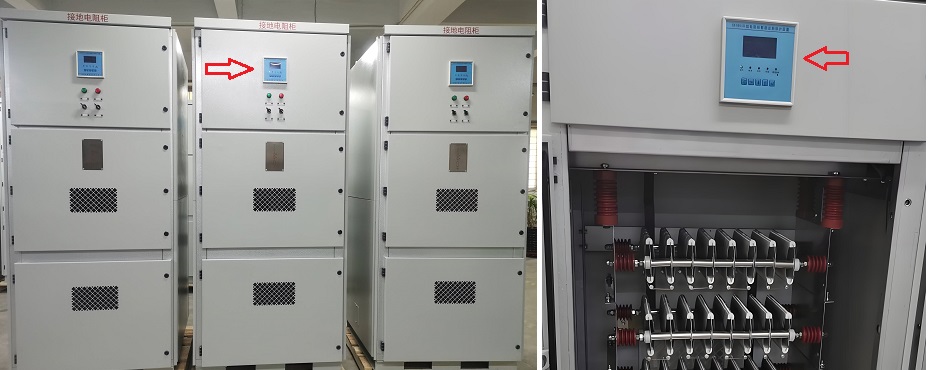
Without monitoring capabilities, issues such as open circuits, connection faults, or abnormal temperatures could arise in the NGR without the operating personnel becoming aware of them in time.
It is only when a ground fault actually occurs that the NGR is required to perform its most critical function under abnormal operating conditions.
Intelligent monitoring systems have changed this situation; by continuously monitoring the NGR and its associated operating parameters, they make the device's status and operational history visible.
This transforms the NGR from a device with limited operational information into an intelligent unit capable of maintaining a comprehensive record of its operating data.
For instance, following a ground fault, operations and maintenance personnel can use the historical records to determine:
1.The magnitude of the fault current;
2.The duration of the fault;
3.The number of ground fault events that have occurred;
4.Whether there was an abnormal rise in resistor temperature;
5.Whether the NGR was already in an abnormal state prior to the fault.
6.Such information is of practical value for fault analysis, equipment maintenance,
and the evaluation of protection systems.
3. Real-Time Condition Perception via Intelligent Controllers
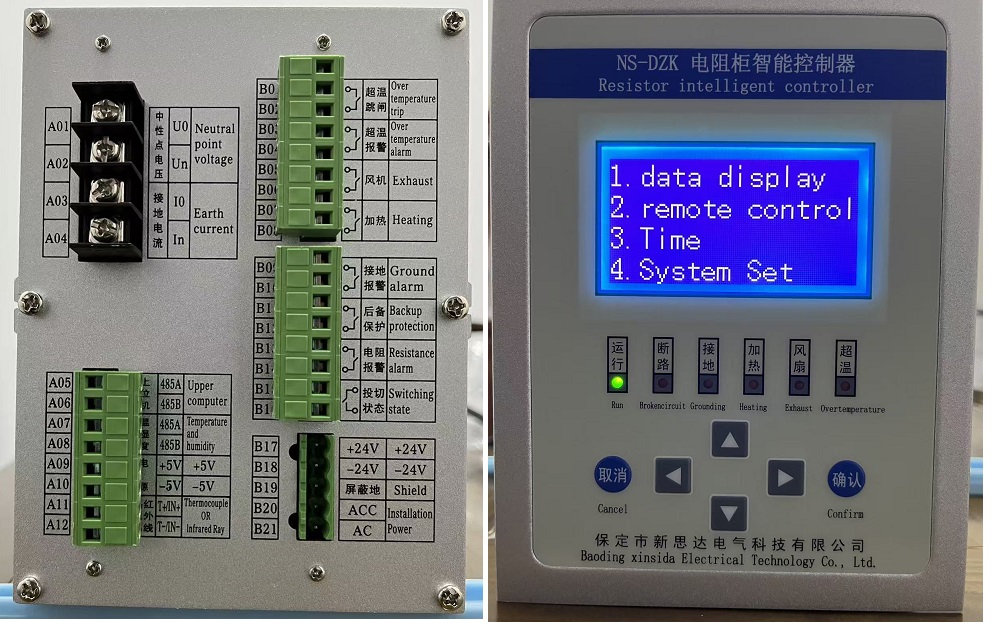
Whereas conventional NGRs rely on manual visual inspection after a fault, an intelligent NGR controller continuously collects and logs system operational parameters.
During normal steady-state operation, the system monitors zero-sequence current and neutral displacement voltage. When a ground fault occurs, it records ground-fault current, initiation timestamp, fault duration, and fault count. Additional monitored metrics include:
Resistor element temperature
Enclosure ambient temperature
Internal enclosure humidity
Resistor loop continuity
Grounding status
This data grants maintenance teams clear operational visibility—knowing precisely "what happened previously and what state the equipment is in now"—to support fault investigation and condition-based maintenance.
4. Multi-Level Alarm and Protection Functions
An intelligent NGR controller performs both diagnostics and configurable alarm/protection logic, including: ground-fault alarms, resistor overtemperature trips/alarms, open-circuit continuity warnings, enclosure environmental alerts, and ground-fault timeout alarms.
Fault duration is critical because thermal energy absorbed by the resistor scales according to E = I2Rt. For a 500 A fault, a 60-second clearing time imposes vastly higher thermal stress than a 10-second duration. Simultaneous logging of current magnitude and duration provides crucial diagnostic data to evaluate actual thermal stress on resistor elements.
5. Seamless Integration into Digital Substation Operations
Equipped with standard communication interfaces (such as Modbus RTU/TCP or IEC 61850), intelligent NGRs transmit real-time telemetry, alarm statuses, and event logs directly to control rooms, SCADA, or asset management platforms.
Operators can track NGR health, ground-fault records, temperature profiles, and alarm histories remotely without frequent site visits. This remote capability is vital for renewable energy plants, unattended substations, and large industrial facilities.
Conclusion
Driven by rapid renewable expansion, growing grid complexity, and substation automation, the NGR has evolved from a simple passive current-limiting component into a smart asset within neutral grounding architectures.
By monitoring zero-sequence voltage/current, fault duration, temperature, humidity, and loop continuity—and combining these with multi-level alarms and remote communications—intelligent monitoring renders the NGR measurable, observable, communicable, and traceable. Intelligent monitoring does not replace the resistor's proven current-limiting principle; it adds essential perception and management capabilities for modern electrical grids.
CATEGORIES
- Neutral Grounding Resistor for Transformer
- Generator Neutral Grounding Resistor
- Low Voltage Neutral Grounding Resistor
- Neutral Grounding Arc Suppression Coils (Peterson Coil)
- Neutral Point Gap Grounding Protection Device
- Nitrogen Injection Fire Protection System for Transformer (NIFPS)
- Transformer Air-Cooled Control Equipment
- Nonlinear Neutral Grounding Equipment
LATEST NEWS
- Why Does the Neutral Point of a Large Generator Need to be Reliably Grounded?
- Transformer Neutral Grounding Methods and Applications for High-, Medium-, and Low-Voltage Systems
- How to Accurately Calculate the Neutral Grounding Resistance Value of a Transformer
- Global Top 8 Neutral Grounding Resistor (NGR)Manufacturers
- Why Do Neutral Grounding Resistor (NGR)Need Intelligent Monitoring?
CONTACT US
WhatsApp:
Tel: +86-312-5959618
Email: info@orionresistors.com
Add: No. 79, Fuchang Road, Zhongguancun Entrepreneurship Base, Baoding City,China