How to Size the Dimensions and Space for an NGR Cabinet?
Writer: admin Time:2026-08-28 18:57:27 Browse:260℃
In power system engineering design, the Neutral Grounding Resistor (NGR) cabinet serves as a critical current‑limiting protection device for 6‑35 kV distribution networks and auxiliary power systems of power plants. Its cabinet outline dimensions and internal space are not standardized fixed values. Instead, they are jointly determined by multiple constraints including electrical parameters, thermal capacity, insulation margin, built‑in components and on‑site installation conditions. The core constraints for NGR cabinet dimensioning and practical application case analysis are presented below:
1. System Voltage Level and Insulation Clearance (Primary Constraint)
System rated voltage forms the fundamental basis for cabinet space determination. Higher voltage levels impose stricter requirements on air clearance and creepage distance for resistor elements, supporting insulators, internal busbars and cable entry bushings. For instance, cabinets for 35 kV systems are considerably larger than those for 10 kV and 6 kV applications. Sufficient space shall be reserved to prevent phase‑to‑ground and phase‑to‑phase flashover risks.
2. Thermal Capacity and Resistor Element Arrangement (Thermal & Power Dissipation)
Fault current, resistance value and current‑carrying duration (e.g. 10 s or 30 s) directly govern the physical size of resistor assemblies. During single‑phase‑to‑ground faults, resistor grids absorb and dissipate massive thermal energy within a short period. Larger fault current or longer fault duration requires more series‑parallel resistor grid modules. For high‑current applications, increased quantity of resistor bank modules demands adequate mounting space and unobstructed convection cooling passages inside the cabinet.
3. Protection Rating and Ventilation Design (IP Rating & Ventilation)
Most NGR cabinets adopt natural air cooling, with air intake at cabinet bottom and air outlet at top or side panels to establish thermal convection. Excess‑compact internal layout causes heat accumulation, which triggers resistor overheating and accelerated degradation of insulating components. For outdoor‑type units, while meeting IP54 / IP55 protection requirements, rain‑proof louvers and labyrinth‑type sealing structures occupy additional cabinet dimensions. Miniaturization shall never be achieved at the expense of heat dissipation performance.
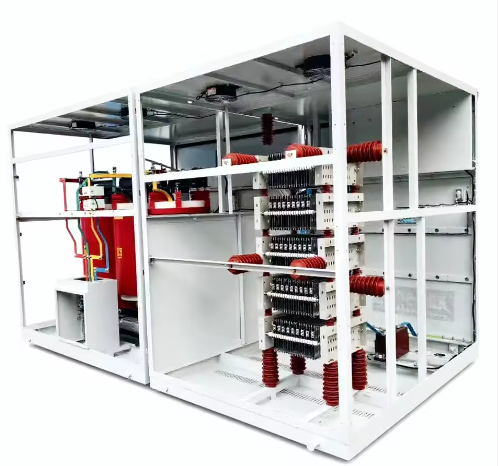
4. Built‑in Functional Components and Auxiliary Devices
Internal assembled devices directly occupy cabinet volume. More installed equipment such as vacuum circuit breakers / contactors, disconnectors, current transformers (CT), metal‑oxide arresters (MOA), intelligent monitoring terminals and anti‑condensation heaters requires larger wiring space and safety clearances. For systems without native neutral point, if a Z‑type grounding transformer is integrated inside the cabinet, the overall cabinet volume will increase significantly.
5. Practical Case Study: 11 kV / 200 A / 31.8 Ω Industrial‑grade NGR Cabinet
Take a typical 11 kV NGR cabinet with rated fault current 200 A, resistance 31.8 Ω and 10‑second rated duration as an example for dimension‑design illustration:
‑ Insulation and electrical clearance: For 11 kV systems, typical dielectric requirements are 28 kV / 1 min power‑frequency withstand and 75 kV lightning impulse withstand. The minimum air clearance between live parts and cabinet enclosure as well as inter‑phase clearance shall be maintained above 120 mm. An extra 300‑400 mm space shall be reserved for bending and insulation protection for top‑entry bushings or cable boxes.
‑ Resistor assembly volume: Short‑time thermal power reaches 1272 kW under fault conditions. Stainless steel (SS304 / SS316) resistor grids with high thermal capacity are adopted. To guarantee heat dissipation and insulation performance, resistor banks are generally divided into 2‑3 stacked modules, which occupy approximately 40 % of the cabinet’s inner core space.
‑ Component layout space: 600/1 A protective‑class CT, metal‑oxide arresters (MOA) and anti‑condensation heaters are installed inside. Arresters and CT are arranged at the bottom or side cable‑inlet area to satisfy safety clearances, meanwhile maintenance access is preserved.
‑ Final cabinet dimensions: With natural convection cooling (bottom mesh air intake, top rain‑hood air outlet) and IP55 outdoor protection fulfilled, typical cabinet dimensions for this 11 kV / 200 A / 31.8 Ω NGR are 1200 mm (W) × 1300 mm (D) × 2100 mm (H). If side‑ or top‑outlet bushing boxes are fitted on top, overall height may extend to 2400 mm.
6. Ambient and On‑site Installation Conditions (Site & Environmental Adaptation)
Outdoor cabinets are equipped with rain‑proof eaves and anti‑corrosion coatings. For high‑altitude applications (above 2000 m above sea level), reduced air dielectric strength requires proportionally enlarged electrical clearances in accordance with relevant standards. Cable‑connection modes (top‑in & bottom‑out, bottom‑in & bottom‑out) determine bushing mounting positions and cabinet height. Sufficient space shall be reserved for on‑site inspection and component replacement regarding cabinet door opening range and inner layout.
CATEGORIES
- Neutral Grounding Resistor for Transformer
- Generator Neutral Grounding Resistor
- Low Voltage Neutral Grounding Resistor
- Neutral Grounding Arc Suppression Coils (Peterson Coil)
- Neutral Point Gap Grounding Protection Device
- Nitrogen Injection Fire Protection System for Transformer (NIFPS)
- Transformer Air-Cooled Control Equipment
- Nonlinear Neutral Grounding Equipment
LATEST NEWS
- Why Does the Neutral Point of a Large Generator Need to be Reliably Grounded?
- Transformer Neutral Grounding Methods and Applications for High-, Medium-, and Low-Voltage Systems
- How to Accurately Calculate the Neutral Grounding Resistance Value of a Transformer
- Global Top 8 Neutral Grounding Resistor (NGR)Manufacturers
- What Are the Routine and Type Tests for a Transformer Neutral Grounding Resistor (NGR)?
CONTACT US
WhatsApp:
Tel: +86-312-5959618
Email: info@orionresistors.com
Add: No. 79, Fuchang Road, Zhongguancun Entrepreneurship Base, Baoding City,China