How Neutral Grounding Resistors (NGR) Tame Destructive Fault Currents
Writer: admin Time:2026-03-23 13:26:35 Browse:312℃
In ungrounded networks, a Single Phase-to-Ground (SLG) fault triggers a "neutral displacement," causing the neutral voltage to drift and subsequently increasing the voltage of the healthy phases. While systems utilizing a Neutral Grounding Resistor (NGR) undergo a similar process, the NGR’s core advantage—**damping—**fundamentally alters the progression of the fault. Physically, the NGR transforms an chaotic release of capacitive energy into controlled resistive dissipation, effectively taming destructive fault currents.
The role of the NGR extends beyond merely limiting fault current; its performance in transient damping is even more critical, particularly in suppressing overvoltages generated during the moment of fault arc extinction. When an arc extinguishes, the grid releases a significant amount of residual charge. Without suppression, this energy can trigger a "restrike" effect, leading to repeated ignition and extinction of the arc within a half-cycle. This creates oscillating voltage spikes that can result in cascading insulation breakdown—a devastating blow to the grid. By providing a discharge path for this charge, the NGR absorbs this transient energy and forces the electromagnetic oscillation to decay rapidly, preventing the restrike phenomenon and providing deterministic protection.
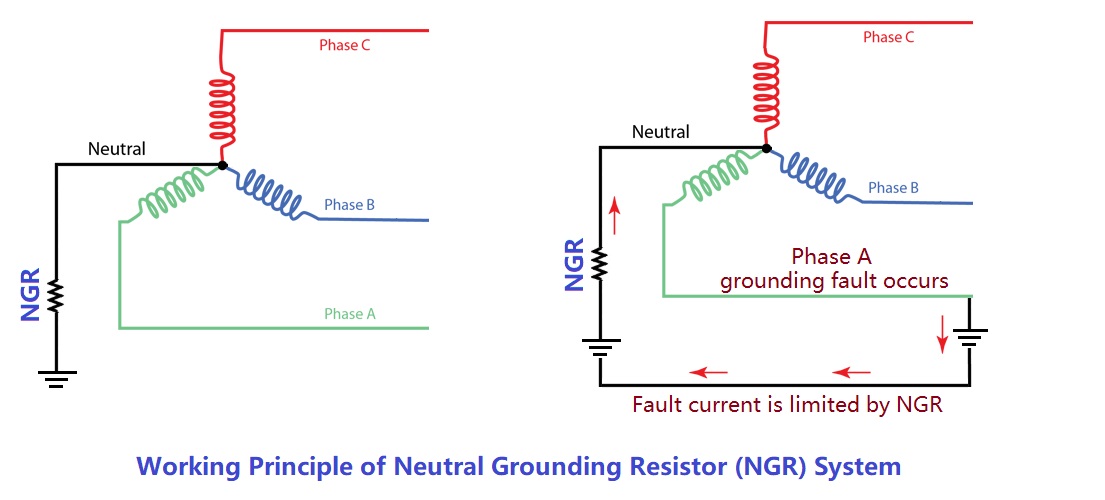
In contrast, ungrounded systems lack an effective energy absorption mechanism during arc extinction, making them highly susceptible to destructive "restrike" overvoltages that threaten system insulation. The NGR acts as the grid’s "stabilizer" or "energy buffer," absorbing transient energy to suppress voltage peaks. This transition from "capacitive volatility" to "resistive stability" is the technical cornerstone for safeguarding core assets like transformers and cables.
For Medium Voltage and High Voltage (MV/HV) grid design, the choice of neutral grounding is paramount. It affects not only personnel safety but also the operational characteristics and reliability of the entire system. Selecting the appropriate NGR is a core decision in this process.
The resistance value (RN) of the NGR directly dictates the direction of the protection strategy, which can be categorized into two primary scenarios:
1.Low Resistance Grounding (LRG): The primary goal is to provide a fault current large enough (typically 100A to 1000A) to ensure that protective relay devices can accurately identify the fault location and achieve selective tripping. This strategy "sacrifices" the continuity of a local circuit to provide ultimate protection for expensive assets, such as transformers and motors, against prolonged electromagnetic stress.
2.High Resistance Grounding (HRG): The focus is on limiting the fault current below the system's forced tripping threshold (typically less than 10A). In this mode, the system only issues an alarm without immediate tripping. This allows production lines to remain operational during the initial fault, gaining a "golden buffer period" for troubleshooting and successfully balancing power continuity with early warning needs.
Compared to ungrounded systems, the advantages of NGR-grounded systems are prominent, which is why they are so widely adopted:
First, they offer superior overvoltage control, effectively suppressing "arcing grounds" and protecting equipment from voltage surges. Second, they provide flexible protection strategies; based on the setting of RN, operators can choose between immediate tripping (LRG) or alarm-only operation (HRG) to suit different scenarios from municipal distribution to industrial mining. Third, they extend the lifespan of electrical assets by limiting fault currents and overvoltages, significantly reducing the mechanical and thermal stresses on equipment windings. In essence, the application of an NGR elevates the grid from "passively enduring faults" to "actively managing faults."
At Voltage Voyage, we view the NGR as the "gatekeeper" of electrical nodes, precisely controlling the scale of fault currents and keeping transient disturbances strictly within safe limits to build a strong defense for stable operation. We believe that deep understanding and precise application of such critical details are the keys to transitioning from a standard grid to a high-resiliency, high-reliability power system.
Mastering the "Golden Rule" of NGR application is essential: The NGR grounding current (IRN) must always be greater than or equal to the system's charging current (Ic). Only when this condition is met (ensuring resistive current dominance) can the system's resonance conditions be effectively disrupted. This allows the damping advantages of the NGR to be fully realized, achieving the ultimate goal of taming fault currents and ensuring the safe and stable operation of the power grid.
CATEGORIES
- Neutral Grounding Resistor for Transformer
- Generator Neutral Grounding Resistor
- Low Voltage Neutral Grounding Resistor
- Neutral Grounding Arc Suppression Coils (Peterson Coil)
- Neutral Point Gap Grounding Protection Device
- Nitrogen Injection Fire Protection System for Transformer (NIFPS)
- Transformer Air-Cooled Control Equipment
- Nonlinear Neutral Grounding Equipment
LATEST NEWS
- Why Does the Neutral Point of a Large Generator Need to be Reliably Grounded?
- Transformer Neutral Grounding Methods and Applications for High-, Medium-, and Low-Voltage Systems
- How to Accurately Calculate the Neutral Grounding Resistance Value of a Transformer
- Global Top 8 Neutral Grounding Resistor (NGR)Manufacturers
- How to Accurately Select the Insulation Level of a Neutral Grounding Resistor?
CONTACT US
WhatsApp:
Tel: +86-312-5959618
Email: info@orionresistors.com
Add: No. 79, Fuchang Road, Zhongguancun Entrepreneurship Base, Baoding City,China