What Is a Neutral-Point Grounding Resistor Cabinet?
Writer: admin Time:2026-04-14 17:49:04 Browse:241℃
A neutral-point grounding resistor cabinet (sometimes called a Neutral Grounding Resistor Cabinet, or NGR cabinet) is a piece of equipment that connects the neutral point of a generator/transformer system to earth through a small resistance. By doing so, fault current is limited to an appropriate value, which improves the sensitivity of protective relays to trip, while also ensuring that a ground fault typically results only in a local, minor burn rather than catastrophic damage. It limits transient overvoltage to about 2.6 times the normal line-to-neutral voltage, prevents arc re-ignition and surge-overvoltage at arc-gaps from damaging major equipment, and effectively suppresses ferroresonance overvoltages, thus ensuring that the generator or transformer can continue to operate safely and normally.
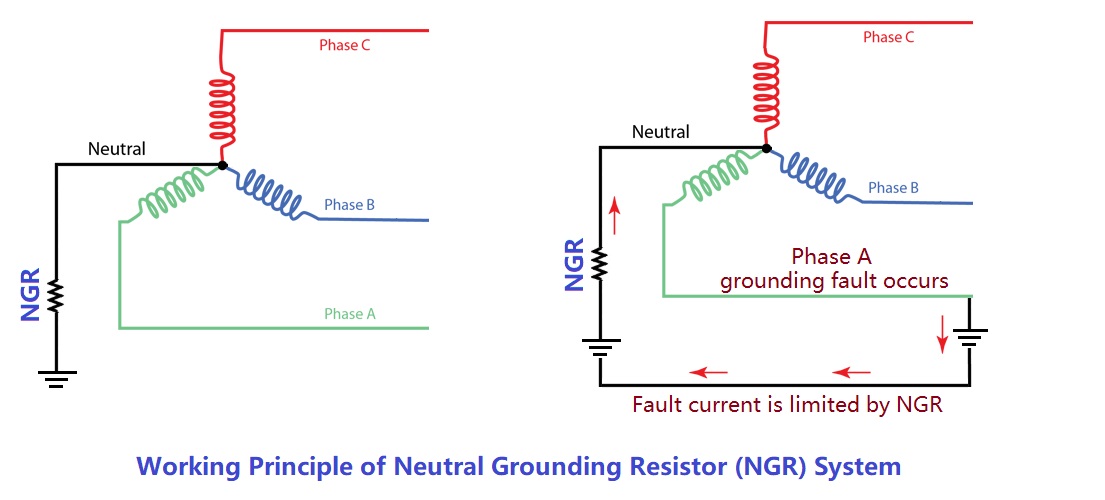
The grounding resistor cabinet is mainly categorized by application into three types:
1.Generator neutral-point grounding resistor cabinet
2.Transformer neutral-point grounding resistor cabinet
3.Low-voltage grounding resistor cabinet
The grounding resistor cabinet typically comprises: a single-phase or three-phase earthing/grounding transformer (or zig-zag transformer where required), a resistor bank, current transformer (CT) for neutral current monitoring, an isolation/disconnect switch, intelligent monitoring/control unit, cabinet enclosure and associated accessories. The dry-type grounding transformer uses aluminum or copper conductors; the resistor bank uses high-quality stainless-steel or nickel-chromium alloy elements, with high current carry capacity, resistance to high temperature and corrosion, good toughness and deformation resistance, and high reliability.
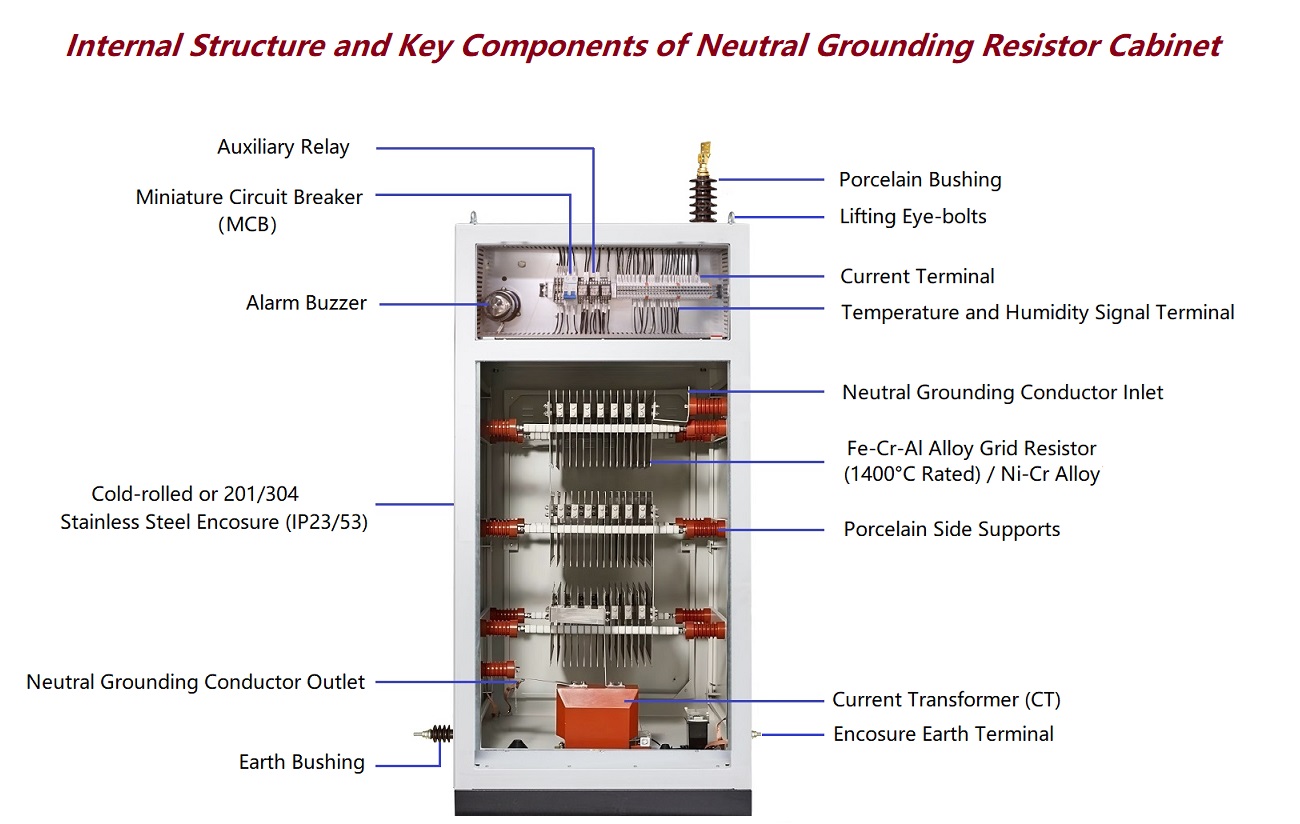
Structural/Design Requirements
1.The structural design, electrical installation, circuit wiring and internal arrangement must be safe and reliable; operation must be flexible and maintenance convenient.
2.The resistor elements must ensure electrical and mechanical stability within the rated operating temperature range; the resistor material shall be stainless steel alloy.
3.The mechanical structure of the resistor bank should be a grille or framework design with sufficient strength to resist vibration; the individual resistor plates/sheets should be welded (e.g., spot welding, TIG/argon‐arc welding) and must not rely on bolted/screw connections which can loosen.
4.The support insulators for the resistor bank must meet the requirements of IEC 60168 or equivalent (formerly IEC 8287), and must operate normally at the specified temperature rise.
5.The resistor bank’s outer enclosure or bushings must comply with IEC 60529 (Ingress Protection) and IEC 61641 (switchgear for rated voltages above 1 kV) or equivalent standard.
6.The resistor elements must comply with international resistor alloy standard such as IEC 60246 or ASTM B593 (or equivalent high‐resistance heating alloy standard).
7.The components of the resistor cabinet should be interchangeable (modular design).
8.The current transformer must be installed in a position avoiding the heat generated by the resistor bank; its secondary terminals should be connected to a terminal block mounted on the cabinet for convenient maintenance.
Conclusion
In modern medium-voltage distribution and generation systems, the neutral-point grounding resistor cabinet plays a key role in limiting ground-fault current, enhancing protection sensitivity, reducing equipment stress, suppressing transient overvoltage (including ferroresonance), and improving overall system reliability and safety. When designing such equipment, adherence to international standards (such as IEEE Std C57.32.2015 for neutral-grounding devices) and industry best practices ensures that the performance and safety requirements are met, and the investment in system protection is optimized.
CATEGORIES
- Neutral Grounding Resistor for Transformer
- Generator Neutral Grounding Resistor
- Low Voltage Neutral Grounding Resistor
- Neutral Grounding Arc Suppression Coils (Peterson Coil)
- Neutral Point Gap Grounding Protection Device
- Nitrogen Injection Fire Protection System for Transformer (NIFPS)
- Transformer Air-Cooled Control Equipment
- Nonlinear Neutral Grounding Equipment
LATEST NEWS
- Why Does the Neutral Point of a Large Generator Need to be Reliably Grounded?
- Transformer Neutral Grounding Methods and Applications for High-, Medium-, and Low-Voltage Systems
- How to Accurately Calculate the Neutral Grounding Resistance Value of a Transformer
- Global Top 8 Neutral Grounding Resistor (NGR)Manufacturers
- How to Accurately Select the Insulation Level of a Neutral Grounding Resistor?
CONTACT US
WhatsApp:
Tel: +86-312-5959618
Email: info@orionresistors.com
Add: No. 79, Fuchang Road, Zhongguancun Entrepreneurship Base, Baoding City,China