How Neutral Grounding Resistor (NGR) Saves Million-Dollar Assets in Milliseconds
Writer: admin Time:2026-05-05 19:12:54 Browse:196℃
I. Core Concept: What is an NGR?
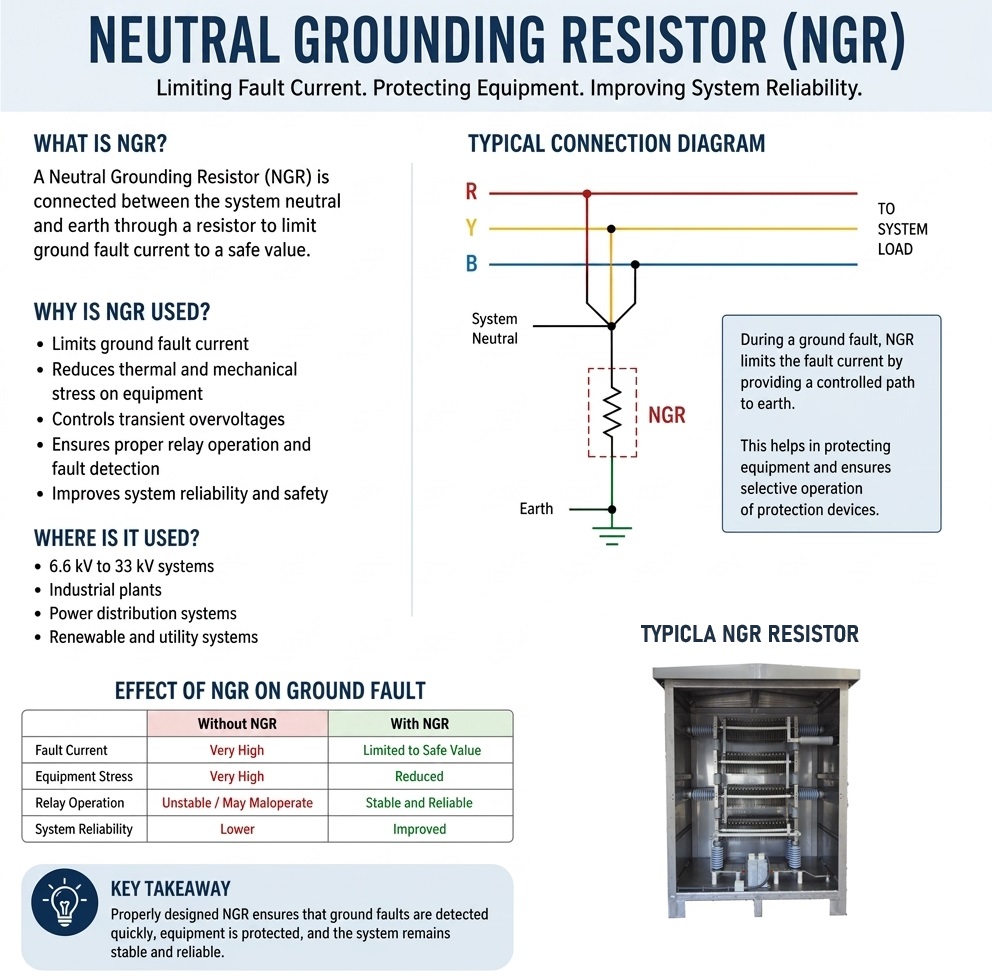
A Neutral Grounding Resistor (NGR) serves as the "current-limiting gatekeeper" within a power system's safety architecture. It is typically connected between the system neutral and earth. While it remains dormant during normal operation, its critical role is triggered during a single line-to-ground fault. By utilizing its physical resistive properties, the NGR limits the sudden burst of fault current to a safe, controllable, and pre-calculated value, effectively transforming destructive energy into a manageable system parameter.
II. Technical Principles: The Art of Balance
The fundamental logic of an NGR is to find the "Golden Balance" for fault current. If the fault current is too high—as seen in solidly grounded systems—extreme thermal stress and mechanical forces can instantaneously destroy cable insulation and damage expensive equipment. Conversely, if the current is too low—as in ungrounded systems—protective relays may fail to detect the fault, allowing it to persist and potentially trigger severe transient overvoltages. Therefore, the NGR functions to ensure both protection sensitivity for relays and physical safety for equipment.
III. Applications and Value: Why It Is Essential
NGRs are indispensable for enhancing reliability in industrial and power distribution systems, particularly those ranging from 6.6 kV to 33 kV. By integrating an NGR, engineers can control transient overvoltages, minimize interference with sensitive electronic equipment, and ensure precise fault detection. This design not only safeguards high-value assets like transformers and generators but also maximizes power continuity by preventing local faults from escalating into massive system-wide outages.
IV. Engineering Case Study: From Instability to Reliability
Consider a 33 kV industrial system that initially lacked a properly designed grounding strategy. During ground faults, excessively high currents led to repeated thermal damage to cable insulation and caused protective relays to operate unstably. After conducting a detailed system study and installing a correctly sized NGR, the transformation was significant: fault currents were strictly limited to safe levels, relay operations became stable and predictable, and the overall system reliability reached a new peak.
Key Takeaway: Grounding design should never be treated as a mere "standard checklist item". It is a critical design decision that must be based on detailed system studies and specific protection requirements to ensure optimal performance.
CATEGORIES
- Neutral Grounding Resistor for Transformer
- Generator Neutral Grounding Resistor
- Low Voltage Neutral Grounding Resistor
- Neutral Grounding Arc Suppression Coils (Peterson Coil)
- Neutral Point Gap Grounding Protection Device
- Nitrogen Injection Fire Protection System for Transformer (NIFPS)
- Transformer Air-Cooled Control Equipment
- Nonlinear Neutral Grounding Equipment
LATEST NEWS
- Why Does the Neutral Point of a Large Generator Need to be Reliably Grounded?
- Transformer Neutral Grounding Methods and Applications for High-, Medium-, and Low-Voltage Systems
- How to Accurately Calculate the Neutral Grounding Resistance Value of a Transformer
- Global Top 8 Neutral Grounding Resistor (NGR)Manufacturers
- How to Accurately Select the Insulation Level of a Neutral Grounding Resistor?
CONTACT US
WhatsApp:
Tel: +86-312-5959618
Email: info@orionresistors.com
Add: No. 79, Fuchang Road, Zhongguancun Entrepreneurship Base, Baoding City,China