The Double-Edged Sword of Grounding Systems: Ungrounded Neutral Systems
Writer: admin Time:2026-01-06 16:22:08 Browse:296℃
The Necessity of Strategic Neutral Grounding
In modern power distribution, selecting a neutral grounding strategy is a critical decision that balances equipment safety with operational uptime. As power grids expand—replacing overhead lines with extensive cable networks—the inherent "capacitive charging current" increases. This shift makes managing ground faults more complex. While an ungrounded system once sufficed for simple grids, today’s high-capacity environments require a more controlled response to prevent catastrophic insulation failure and transient overvoltages.
Typically, grounding systems are classified into four categories: Solidly Grounded, Reactance Grounding, Resistance Grounding (NGR), and Ungrounded Systems. Each has its trade-offs. However, to understand why many industries are now moving toward NGR solutions, we must first examine the most traditional and controversial approach: the Ungrounded System.
Often described as a "double-edged sword," the ungrounded system presents a unique set of advantages and risks...
Main Advantages
High continuity of power supply:
When a single-phase-to-ground fault occurs, no effective fault current loop is formed, so the ground-fault current is very small and the three phase-to-phase voltages remain symmetrical. The system is allowed to operate with the fault for a short period (typically up to 2 hours) without immediate tripping, which greatly improves supply reliability.Relatively good safety performance:
Because the fault current is weak, it is unlikely to generate large currents at the fault point that could cause fires. Interference with communication lines is also relatively small.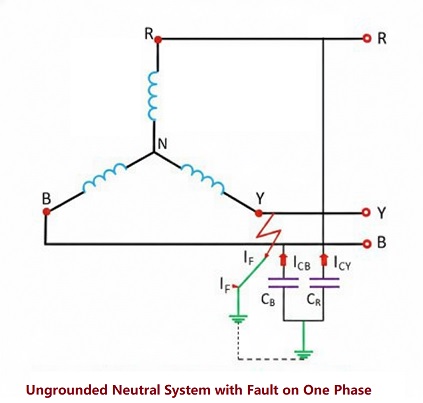
Main Disadvantages
Overvoltage risk:
During a single-phase-to-ground fault, the phase-to-ground voltage of the healthy phases rises to the line voltage (i.e., √3 times the normal value). If intermittent arcing ground faults occur, multiple-times arcing overvoltages may be excited, posing a serious threat to equipment insulation.Difficulty in fault location:
The small fault current prevents conventional overcurrent protection from operating. Expensive insulation monitoring devices or special fault-line selection equipment are required to detect and locate the fault.High insulation requirements:
Equipment insulation must be designed to withstand line-to-line voltage levels, increasing the initial investment cost.
Summary and Recommendation
This type of system is most suitable for industrial installations where power interruptions are extremely unacceptable. If your system has a large number of cables and the resulting capacitive earth-fault current becomes excessive (typically exceeding 10–30 A), it is generally recommended to adopt resistance grounding or arc-suppression coil (Petersen coil) grounding, which you have previously reviewed.
An ungrounded neutral system is truly a double-edged sword: it sacrifices insulation safety in exchange for maximum supply continuity. It was an effective solution in early power networks with small capacitive currents, but in modern urban cable-dominated medium-voltage networks, its negative effects often outweigh its benefits.
This is precisely why the current trend is to add a Neutral Grounding Resistor (NGR) cabinet—essentially fitting a “scabbard” to this double-edged sword—retaining a degree of system stability while effectively limiting overvoltages through resistance grounding.

CATEGORIES
- Neutral Grounding Resistor for Transformer
- Generator Neutral Grounding Resistor
- Low Voltage Neutral Grounding Resistor
- Neutral Grounding Arc Suppression Coils (Peterson Coil)
- Neutral Point Gap Grounding Protection Device
- Nitrogen Injection Fire Protection System for Transformer (NIFPS)
- Transformer Air-Cooled Control Equipment
- Nonlinear Neutral Grounding Equipment
LATEST NEWS
- Why Does the Neutral Point of a Large Generator Need to be Reliably Grounded?
- Transformer Neutral Grounding Methods and Applications for High-, Medium-, and Low-Voltage Systems
- How to Accurately Calculate the Neutral Grounding Resistance Value of a Transformer
- Global Top 8 Neutral Grounding Resistor (NGR)Manufacturers
- How to Accurately Select the Insulation Level of a Neutral Grounding Resistor?
CONTACT US
WhatsApp:
Tel: +86-312-5959618
Email: info@orionresistors.com
Add: No. 79, Fuchang Road, Zhongguancun Entrepreneurship Base, Baoding City,China