The Importance of Neutral Grounding Systems at a Glance
Writer: admin Time:2026-06-15 16:44:54 Browse:145℃
1. Core Functions of Neutral Grounding Resistors (NGR)
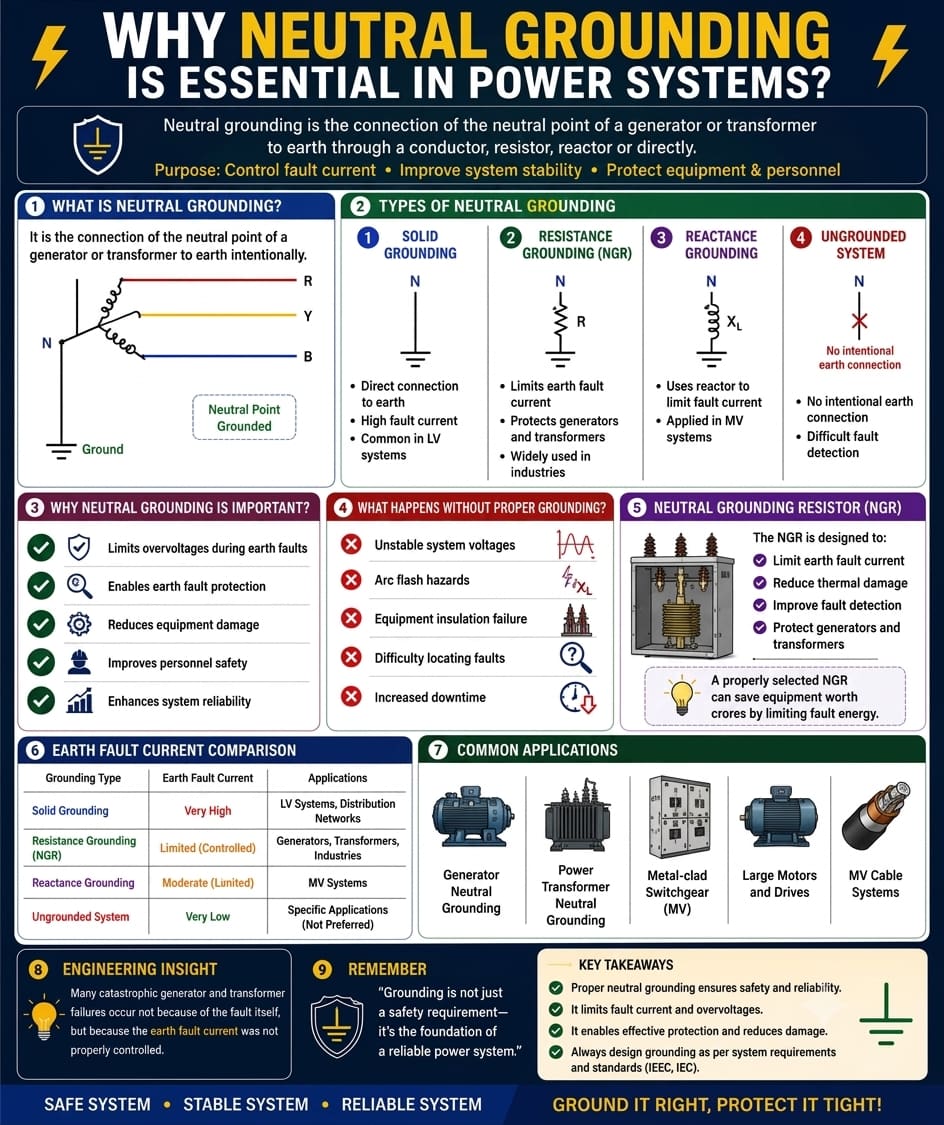
Neutral Grounding Resistors (NGRs) are core protective components in power systems, typically connected in series between the neutral point of transformers or generators and the earth. As a vital part of resistance-grounding systems, an NGR does not block faults. Instead, it precisely limits single-phase grounding fault currents and suppresses system overvoltages, balancing equipment safety with power supply reliability. It is an indispensable asset in medium- and high-voltage distribution networks.
2. Classification by Resistance & Current-Limiting Features
Depending on the resistance value and current-limiting characteristics, NGRs are classified into two main types in practical applications:
Low-Resistance Grounding (LRG): Designed for high- or medium-voltage distribution systems, LRG limits the fault current to 50–1000 A. Its primary advantage is that it rapidly and selectively triggers relay protection devices to trip and isolate the faulted line instantly, while keeping the current low enough to prevent catastrophic thermal damage to equipment.
High-Resistance Grounding (HRG): Ideal for applications demanding exceptional power continuity (such as chemical plants, metallurgical facilities, and large data centers), HRG restricts the fault current to a mere 5–10 A. When a single-phase grounding fault occurs, the system can continue operating safely for a short period without tripping, only issuing an alarm signal. This buys crucial time for maintenance crews to locate the fault, drastically reducing downtime losses.
3. Comprehensive Comparison of the Four Main Grounding Modes
In modern power systems, neutral grounding methods are primarily classified into four types. Fault currents and overvoltage characteristics vary dramatically across these approaches:
Solidly Grounded System (Effectively Grounded): When a single-phase grounding fault occurs, the fault current can skyrocket to thousands of amperes, turning into a severe short-circuit current. Although the voltage of the healthy phases does not rise, this extreme current puts immense electrodynamic and thermal stress on equipment, requiring immediate tripping to clear the fault. It is typically applied in extra-high voltage grids of 110 kV and above.
Ungrounded System (Isolated Neutral): When a grounding fault occurs, only a tiny capacitive current flows through the fault point from the entire system's line-to-ground capacitance. While the system can continue operating under a fault condition, this method highly risks triggering intermittent arcing grounding overvoltages. These overvoltages can spike up to 3.5 times the rated voltage, continuously stressing and degrading equipment insulation. It is mostly used in 3–60 kV grids with high continuity demands.
Impedance Grounding System (Arc Suppression Coil Grounding): This is a traditional compensation method. By connecting an inductor (arc suppression coil) to the neutral point, the inductive current neutralizes the line-to-ground capacitive current during a single-phase grounding fault, allowing the arc to extinguish naturally. However, with the widespread use of underground cables, capacitive currents have surged, limiting the compensation accuracy and overvoltage suppression effectiveness of this method in complex scenarios. It is generally found in 3–60 kV overhead-line distribution networks.
Resistance Grounded System (NGR-Grounded): This represents a modern, optimized compromise. By introducing an NGR, the system effectively discharges residual capacitive voltage and smoothly suppresses arcing overvoltages. Furthermore, it artificially restrains the fault current within a controlled, safe, and easily detectable range (5–1000 A), making it ideal for 3–35 kV urban and industrial grids heavily utilizing cables.
4. Severe Hazards of Missing or Failed Grounding Devices
If a power system lacks an appropriate NGR, or if an improper grounding method causes the grounding devices to fail, a dangerous chain reaction can occur:
In Solidly Grounded Systems: Excessive, out-of-bounds fault currents will directly scorch transformer and motor windings, burn line terminals, and trigger devastating arc-flash short circuits and fires.
In Ungrounded & Arc Suppression Coil Systems: If the grid expands without NGR regulation, prolonged exposure to abnormal arcing overvoltages will rapidly accelerate the insulation aging of cables and switchgears, inducing dielectric breakdowns and leakage faults.
Ultimate Consequences: These hazards will inevitably escalate into widespread power outages, core equipment burnout, or even lethal electric shocks, causing cascading grid trips and completely paralyzing the stability of the power supply.
5. Modernized Protection Solutions: Neutral Grounding Resistor Cabinets
The Neutral Grounding Resistor Cabinet is an integrated turnkey solution for NGRs. It encapsulates the grounding resistor, current transformers (CT), monitoring devices, protective elements, and intelligent controllers into a single, cohesive unit featuring dustproof, anti-corrosion, and high-temperature resistant properties.
With its compact footprint and ease of installation, the cabinet provides real-time monitoring of neutral unbalance currents and temperatures while delivering precise fault signal feedback. It is highly adaptable to harsh outdoor, industrial, and mining environments, serving as the standardized equipment to realize neutral resistance grounding.
Conclusion
In summary, among the various grounding methods—solidly grounded, ungrounded, arc suppression coil, and resistance grounded—NGRs and their integrated cabinets strike the perfect balance between fault current limitation, overvoltage protection, and power supply reliability. By mitigating the risks of insulation breakdown and equipment burnout caused by grounding faults, they safeguard both electrical assets and human lives, forming an essential shield for the safe and stable operation of modern power systems.
CATEGORIES
- Neutral Grounding Resistor for Transformer
- Generator Neutral Grounding Resistor
- Low Voltage Neutral Grounding Resistor
- Neutral Grounding Arc Suppression Coils (Peterson Coil)
- Neutral Point Gap Grounding Protection Device
- Nitrogen Injection Fire Protection System for Transformer (NIFPS)
- Transformer Air-Cooled Control Equipment
- Nonlinear Neutral Grounding Equipment
LATEST NEWS
- Why Does the Neutral Point of a Large Generator Need to be Reliably Grounded?
- Transformer Neutral Grounding Methods and Applications for High-, Medium-, and Low-Voltage Systems
- How to Accurately Calculate the Neutral Grounding Resistance Value of a Transformer
- Global Top 8 Neutral Grounding Resistor (NGR)Manufacturers
- How to Accurately Select the Insulation Level of a Neutral Grounding Resistor?
CONTACT US
WhatsApp:
Tel: +86-312-5959618
Email: info@orionresistors.com
Add: No. 79, Fuchang Road, Zhongguancun Entrepreneurship Base, Baoding City,China