The Most Overlooked Data in NGR Selection----Altitude
Writer: admin Time:2026-09-24 13:04:45 Browse:111℃
When selecting a neutral grounding resistor (NGR), engineers typically focus on system voltage, resistance, ground-fault current, and fault duration. However, installation altitude is also an important NGR selection parameter, especially for medium-voltage systems installed in mountainous or high-altitude regions.
As altitude increases, atmospheric pressure and air density decrease. This can affect the external insulation performance and heat dissipation of an NGR. At the same time, CTs, VTs, controllers, relays, sensors, and other auxiliary components may have specific altitude limitations.
Therefore, a high-altitude NGR should not simply be selected by matching voltage, resistance, and fault current. The manufacturer should also verify insulation coordination, thermal performance, component ratings, ventilation, and environmental conditions according to the actual installation altitude.
Why Is Altitude Important for NGR Selection?
Altitude primarily affects an NGR in three areas:
External insulation performance
Thermal dissipation and resistor temperature rise
Altitude suitability of auxiliary components
For installations above the standard service altitude, these factors may require additional engineering verification or design adjustment.
IEC 60076-25:2023 specifically covers neutral grounding resistors for transformers and generators, including their service conditions, characteristics, tests, and test methods. IEC 60071-2 provides guidance for insulation coordination in AC systems above 1 kV, while applicable high-voltage switchgear standards also address altitude-related corrections.
The actual design requirements should always be determined according to the applicable standards, project specifications, and site conditions.
How Does High Altitude Affect NGR Insulation?
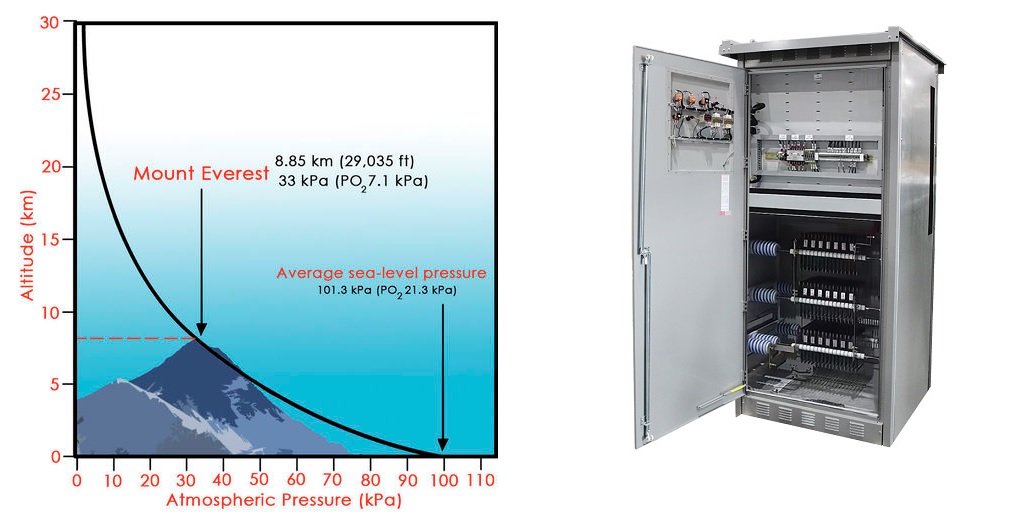
One of the most important effects of altitude is the reduction in atmospheric pressure.
As altitude increases, the density of air decreases, reducing the dielectric strength of air. For an air-insulated NGR, this can affect the withstand capability of the air gaps between energized conductors and grounded components.
Typical areas requiring review include:
Phase-to-ground clearance
Phase-to-phase clearance
Creepage distance
Insulator withstand capability
Power-frequency withstand voltage
Lightning impulse withstand level
Overall insulation coordination
An NGR designed for standard atmospheric conditions may therefore require additional insulation verification when installed at significantly higher altitude.
However, it is not technically correct to assume that every high-altitude NGR automatically requires longer creepage distances or a higher insulation class. The required solution depends on the insulation level, equipment construction, pollution level, insulating materials, and applicable standards.
What Is NGR Altitude Correction?
NGR altitude correction is essentially the engineering process of verifying whether the electrical insulation and thermal performance of an NGR remain adequate at the specified installation altitude.
Depending on the project, the manufacturer may need to:
Review electrical clearances
Review creepage distances
Select suitable insulators
Verify insulation withstand levels
Apply applicable altitude correction factors
Check the altitude ratings of auxiliary components
The objective is to maintain sufficient insulation margin under the actual atmospheric conditions at the installation site.
How Does Altitude Affect NGR Heat Dissipation?
The second major consideration is thermal performance.
During a single-phase ground fault, an NGR carries a high current for a specified period, such as 10 seconds. The resistor elements convert electrical energy into heat:
P = I²R
Although the fault duration is short, the instantaneous thermal load can be substantial.
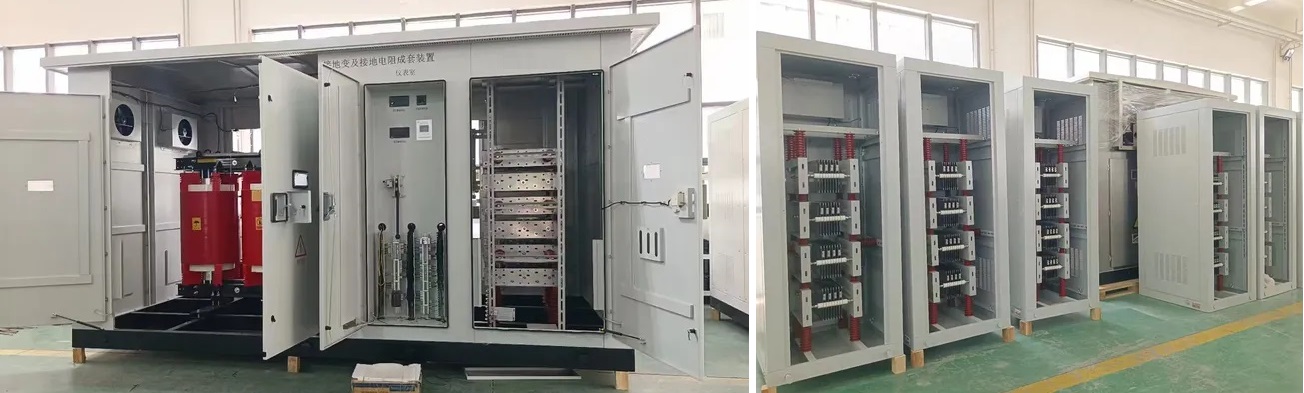
At high altitude, reduced air density can decrease the effectiveness of natural-convection cooling. Consequently, an NGR operating at high altitude may experience a higher temperature rise than the same design operating at a lower altitude under otherwise identical conditions.
For this reason, NGR temperature rise and short-time thermal withstand capability should be rechecked for high-altitude applications.
The thermal evaluation may include:
Resistor element temperature rise
Short-time thermal capacity
Resistor surface area
Airflow and natural convection
Enclosure ventilation
Internal air circulation
Ambient temperature
Fault current
Fault duration
Depending on the calculation results, the manufacturer may need to modify the resistor arrangement, increase the heat-dissipation area, improve ventilation, or make other thermal design adjustments.
Does High Altitude Mean NGR Power Must Be Derated?
Not necessarily.
This is an important distinction.
An NGR is generally designed according to a specified fault current and short-time duty, rather than continuous power output like a conventional power supply.
Therefore, high-altitude design should not simply be described as “reducing the NGR power rating.”
Instead, the manufacturer should verify whether the resistor can safely withstand the specified:
Fault Current × Resistance × Fault Duration
while maintaining the required temperature limits.
In other words, the key issue is the short-time thermal withstand capability and temperature rise, not simply a reduction in the nominal resistor power.
Do NGR Auxiliary Components Need Altitude Verification?
Yes.
An NGR system may include many components in addition to the main resistor bank.
| Component | High-Altitude Consideration |
| Resistor elements | Temperature rise and thermal withstand |
| Insulators | Dielectric strength and insulation rating |
| CT | Insulation and altitude rating |
| VT | Insulation and altitude rating |
| Intelligent controller | Operating altitude and temperature range |
| Relay | Insulation and operating conditions |
| Temperature sensor | Measurement range and accuracy |
| Humidity sensor | Operating environment |
| Isolation switch | Insulation and altitude requirements |
| Communication module | Operating temperature and altitude |
High altitude can affect both insulation and cooling conditions. Therefore, each critical auxiliary component should be checked against the manufacturer's specified operating altitude and temperature range.
It is not appropriate to assume that every electronic component will develop partial discharge, measurement errors, or communication problems at high altitude. Instead, the correct engineering approach is to verify the manufacturer's altitude rating and any applicable derating requirements for each component.
This is especially important for intelligent NGR systems that continuously monitor parameters such as zero-sequence current, ground-fault current, resistor temperature, ambient temperature, humidity, and alarm status.
Does Altitude Affect NGR Enclosure Design?
Altitude can also influence the enclosure design indirectly through ventilation and environmental conditions.
High-altitude sites may experience large temperature fluctuations, low air density, strong solar radiation, and specific humidity conditions. These factors should be considered when designing or selecting the NGR enclosure.
Important considerations include:
Natural ventilation
Heat dissipation
Enclosure temperature rise
Condensation protection
Anti-condensation heating
Temperature and humidity monitoring
Cable entry sealing
Enclosure protection level
Condensation should not be attributed to altitude alone. It depends on temperature, relative humidity, enclosure temperature, ventilation, sealing, and other environmental conditions.
For outdoor NGR installations, the enclosure should therefore be evaluated according to the actual site environment and the required IP or NEMA protection level.
Example: Selecting an 11 kV NGR at 2,500 m Altitude
Consider an 11 kV NGR whose standard design is specified for an installation altitude of up to 1,000 m.
Suppose the actual installation site is located at 2,500 m above sea level.
The standard NGR should not simply be selected without additional verification.
1. Insulation Verification
The manufacturer should review the insulation coordination for the specified altitude, including:
Phase-to-ground clearance
Phase-to-phase clearance
Creepage distance
Insulator rating
Power-frequency withstand
Lightning impulse withstand
The actual requirements should be determined according to the applicable standards and project insulation specifications.
2. Thermal Verification
The resistor temperature rise and short-time thermal withstand capability should be recalculated considering the reduced air density at 2,500 m.
If necessary, the resistor structure, heat-dissipation area, ventilation arrangement, or enclosure design may be modified.
3. Auxiliary Component Verification
CTs, VTs, controllers, relays, sensors, and other components should be checked against their specified altitude ratings.
4. Enclosure and Environmental Verification
The manufacturer should evaluate ventilation, temperature rise, condensation protection, and environmental protection based on the actual installation conditions.
The result may be that the standard NGR design is suitable after verification, or that certain design modifications are required.
The important point is that these checks should be completed during the NGR selection and engineering stage, rather than after the equipment arrives at the project site.
What NGR Parameters Should Be Provided for High-Altitude Projects?
When requesting an NGR quotation, buyers should provide the installation altitude together with the electrical parameters.
| NGR Selection Parameter | Example |
| System voltage | 11 kV |
| NGR resistance | 6.35 Ω |
| Ground-fault current | 1,000 A |
| Fault duration | 10 s |
| Installation altitude | 2,500 m |
| Installation location | Indoor / Outdoor |
| Ambient temperature | According to site conditions |
| System frequency | 50 Hz / 60 Hz |
| Enclosure protection | IP54 / NEMA 3R |
| Applicable standards | IEC / IEEE / GB / Project Specification |
For a high-altitude NGR project, installation altitude should be included in the initial RFQ and technical specification.
This allows the manufacturer to determine the appropriate insulation, thermal design, enclosure configuration, and auxiliary components before manufacturing begins.
Does a High-Altitude NGR Require a New Type Test?
Not necessarily.
An installation above 1,000 m does not automatically mean that a completely new NGR type test is required.
The manufacturer should first determine whether the actual installation conditions are covered by:
The existing NGR design
The applicable standards
Existing type-test evidence
The specified service conditions
The project's technical requirements
If the site conditions fall outside the conditions covered by the existing design or verification evidence, additional engineering verification or project-specific testing may be required.
Therefore, the key question is not simply:
“Is the NGR installed above 1,000 m?”
The more useful engineering question is:
“Has the NGR been designed and verified for the actual altitude and environmental conditions of the installation site?”
High-Altitude NGR Selection Checklist
Before ordering an NGR for a high-altitude project, the following information should be confirmed:
| Check Item | Required Action |
| Installation altitude | Confirm actual site elevation |
| System voltage | Confirm line-to-line voltage |
| Ground-fault current | Confirm required NGR current |
| Fault duration | Confirm short-time duty |
| Insulation level | Verify insulation coordination |
| Clearances | Check altitude requirements |
| Creepage distance | Verify according to applicable standards |
| Resistor temperature rise | Perform thermal verification |
| Cooling method | Check natural or forced ventilation |
| CT / VT | Confirm altitude rating |
| Controller | Confirm operating altitude and temperature |
| Enclosure | Check IP / NEMA and environmental requirements |
| Condensation | Evaluate heating and humidity control |
| Type-test evidence | Confirm applicability to site conditions |
Conclusion
Altitude is an important NGR selection parameter and should be considered together with system voltage, resistance, ground-fault current, and fault duration.
For high-altitude installations, the main considerations are:
External insulation: Reduced atmospheric pressure can affect the dielectric strength of air, requiring verification of insulation coordination, clearances, creepage distances, and withstand levels.
Thermal performance: Reduced air density can decrease natural-convection cooling, making resistor temperature rise and short-time thermal withstand important design considerations.
Auxiliary components: CTs, VTs, controllers, relays, sensors, and other components should be checked against their altitude and temperature ratings.
Enclosure and environment: Ventilation, heat dissipation, condensation protection, and enclosure protection should be evaluated according to actual site conditions.
Therefore, altitude should be provided to the NGR manufacturer before the design is finalized. Proper high-altitude verification can help ensure that the NGR maintains adequate insulation, withstands the specified ground-fault duty, and operates reliably throughout its service life.

CATEGORIES
- Neutral Grounding Resistor for Transformer
- Generator Neutral Grounding Resistor
- Low Voltage Neutral Grounding Resistor
- Neutral Grounding Arc Suppression Coils (Peterson Coil)
- Neutral Point Gap Grounding Protection Device
- Nitrogen Injection Fire Protection System for Transformer (NIFPS)
- Transformer Air-Cooled Control Equipment
- Nonlinear Neutral Grounding Equipment
LATEST NEWS
- Why Does the Neutral Point of a Large Generator Need to be Reliably Grounded?
- Transformer Neutral Grounding Methods and Applications for High-, Medium-, and Low-Voltage Systems
- How to Accurately Calculate the Neutral Grounding Resistance Value of a Transformer
- Global Top 8 Neutral Grounding Resistor (NGR)Manufacturers
- What Are the Routine and Type Tests for a Transformer Neutral Grounding Resistor (NGR)?
CONTACT US
WhatsApp:
Tel: +86-312-5959618
Email: info@orionresistors.com
Add: No. 79, Fuchang Road, Zhongguancun Entrepreneurship Base, Baoding City,China