Why 10–15 kV Systems Prefer Low-Resistance Grounding System?
Writer: admin Time:2025-11-16 18:01:00 Browse:354℃
As urban power demand continues to grow rapidly, the traditional 10–15 kV ungrounded neutral system has gradually shown its limitations. Although an ungrounded system can maintain power continuity during a single-phase-to-ground fault, this advantage is increasingly difficult to sustain in modern urban distribution networks. Consequently, 10–15 kV systems are progressively adopting low-resistance grounded neutral configurations. Why has this approach gained wide recognition?
(1) Background and Challenges
In the past, 10–15 kV networks mainly used overhead lines, resulting in a relatively small system-to-ground capacitance current (usually below 10 A). Under such conditions, a single-phase ground fault generated low arc energy and rarely evolved into a phase-to-phase short circuit. Therefore, ungrounded neutral systems were once considered ideal.
However, with the sharp increase in urban electricity demand, the limitations of 10–15 kV overhead supply—restricted transmission capacity and narrow right-of-way—have forced cities to adopt underground cable networks. As cable usage increased, the capacitive current to ground rose dramatically, often exceeding 10 or even 20 A. The resulting higher arc energy causes single-phase ground faults to escalate quickly into phase-to-phase short circuits, forcing upstream breakers to trip and leading to widespread outages.
In this situation, the key advantage of the ungrounded system—continuity of supply during a ground fault—no longer exists. Since power must be interrupted anyway, maintaining an ungrounded 10–15 kV system with higher insulation requirements and costs becomes uneconomical. For this reason, many cities have converted their 10–15 kV networks from ungrounded to low-resistance grounded systems, allowing the feeder breaker at the fault location to trip promptly and reducing insulation and construction costs across the grid.
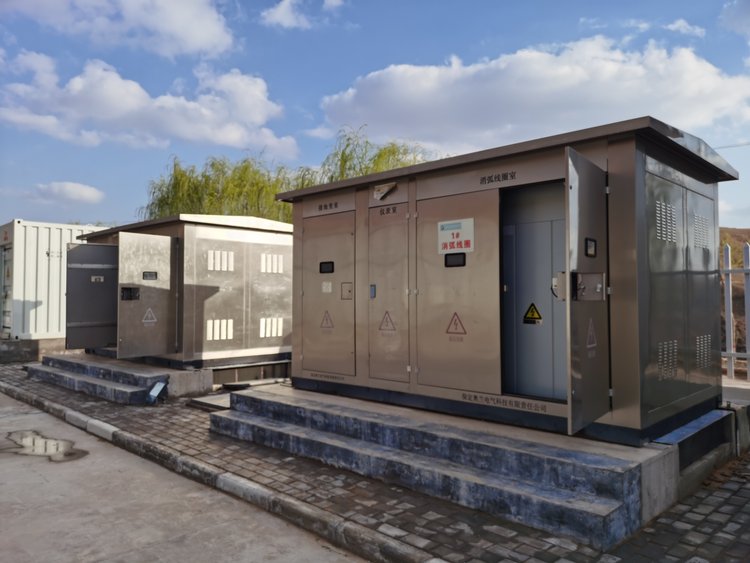
(2) Principle of Low-Resistance Grounding
To address these challenges, many urban distribution networks have adopted low-resistance grounding.
This configuration is implemented by installing a neutral grounding transformer on the 132/33/11 kV transformer secondary side, which is typically connected in delta. The grounding transformer’s primary winding uses a star connection to create an artificial neutral point. A resistor of approximately 10 Ω is connected between this neutral and earth, limiting the ground-fault current to several hundred amperes, typically below 1,000 A.
(3) Performance and Significance
In a 11/0.4 kV substation, when a ground fault occurs on the high-voltage side, the resulting current is no longer a small capacitive current but can reach several hundred amperes or even close to 1 kA.
Under such conditions, protective relays and circuit breakers on the source side can detect the fault reliably and disconnect the circuit within milliseconds.
Because the neutral is grounded through a resistor, the phase-to-ground voltage of the healthy phases rises only moderately. Moreover, since the fault duration is extremely short, the insulation level, air clearance, and creepage distance requirements for 10–15 kV equipment can be significantly reduced. This results in lower equipment manufacturing costs, smaller physical dimensions, and reduced system investment.
Therefore, the low-resistance grounded neutral system offers clear advantages:
1.Enhanced equipment safety
2.Improved relay protection sensitivity,
3.Reduced insulation requirements, and
4.Lower system construction costs.
In summary, as urban distribution networks become more cable-intensive and load density and reliability requirements increase, low-resistance grounding has become the mainstream trend for 10–15 kV systems.
This grounding method balances fault detection sensitivity, system safety, and economic efficiency, making it an optimal choice for modern urban power distribution.

CATEGORIES
- Neutral Grounding Resistor for Transformer
- Generator Neutral Grounding Resistor
- Low Voltage Neutral Grounding Resistor
- Neutral Grounding Arc Suppression Coils (Peterson Coil)
- Neutral Point Gap Grounding Protection Device
- Nitrogen Injection Fire Protection System for Transformer (NIFPS)
- Transformer Air-Cooled Control Equipment
- Nonlinear Neutral Grounding Equipment
LATEST NEWS
- Why Does the Neutral Point of a Large Generator Need to be Reliably Grounded?
- Transformer Neutral Grounding Methods and Applications for High-, Medium-, and Low-Voltage Systems
- How to Accurately Calculate the Neutral Grounding Resistance Value of a Transformer
- Global Top 8 Neutral Grounding Resistor (NGR)Manufacturers
- How to Accurately Select the Insulation Level of a Neutral Grounding Resistor?
CONTACT US
WhatsApp:
Tel: +86-312-5959618
Email: info@orionresistors.com
Add: No. 79, Fuchang Road, Zhongguancun Entrepreneurship Base, Baoding City,China